Southview student continues start-up business

During the pandemic, most people were forced to spend long periods of time in their homes with little to do. This allowed some people to explore other hobbies and passions. For some people, they were able to start a new business. Breyana Kemp, senior at Southview High School, started painting shoes for her business during quarantine called Bresie’s Creations. Her passion for art started when she was a child.
“Ever since I was about five, I’ve been coloring and drawing. When I was younger, I used to look at a TV screen … let’s say SpongeBob and I would just look at it and start drawing the characters by hand.”
Kemp started her business last summer during the pandemic. “Over the summer during COVID, I was bored in the house and then one of my friends asked if I could paint her shoes and I just said yea because she’s my friend. My mom posted it on Facebook, everybody saw it and that’s how my shoe business started.”

A sample of the shoes painted by Southview senior Breyana Kemp.

The price range for her business can range from $50-$100 dollars depending on the shoe type, what kind of paint she must use, and what the customer wants painted on. Painting shoes can be a difficult process depending on what Kemp needs to paint.
“One of my shoes I did I put a whole bunch of cartoon characters on it and you have to get the small eyes and the mouth and it’s really hard to get all the detail on there.”
Kemp says she plans to go to Columbus College of Art and Design to major in graphic illustration and minor in fine arts. The plan for Kemp is to continue her business during college. “During college I’m going to try to continue my business. Then, after college, they have internships and I’m going to see where that takes me.”
People who want to have their shoes painted can reach her on her Facebook page, her Instagram (@bresies_creations), and soon she will have her own website for people to contact her.

LOURDES UNIVERSITY ADJUSTS TO COVID-19

COVID-19 continues to affect the daily lives of almost everyone. One of the biggest groups of people that have been affected are college students. Universities across the country have been forced to quickly adapt to the new normal that the country has faced since March.
On Oct. 27, in Russel Ebeid Hall at Lourdes University, three students discussed their first full semester under the restrictions of COVID-19. The students related how they were or were not affected by remote learning and changes to in-class learning.
Ann Blevins, a junior and a psychology major with a minor in educational studies who lives on campus, said she has two online classes and two in-person classes, and has been largely unaffected by the transition to online classes.
According to a research study published by the National Center for Biotechnology (NCBI) 54 percent (106/195) of students surveyed said they have seen an increase in workload this semester, however, for Blevins, this was not the case. “Honestly, I feel like I have less. I recently just switched my major too, so I feel like I should have a lot of homework, but I really don’t,” she stated.
While some students may say school work is more difficult, Blevins added that her classes have been much easier this semester. “I’m okay with online learning. In-person is better for me but I’m also okay with learning online. That’s never really bothered me.”
Blevins explained some of the new rules for living on campus. “We are only allowed to have seven people in our rooms at a time. It’s affected us hanging out with our friends so we don’t really get to see all the friends that we used to hang out with all the time. It’s harder to plan the time to see this person or see that person when you can only have so many at once.”
Everyone has something that they look forward to when Covid is no longer a threat and Blevins shared what she is looking forward to, “When we can go back to our daily lives, I hate wearing masks, I hate having to be far away from people. I don’t like not being able to see my friends as much as I used too, along with my family as well. I don’t really see my family as much.”
Hayleigh Grega, a Sophomore psychology major who lives at home, struggles with Attention Deficit Disorder (ADD) which has hindered her ability to learn from home. “I am really someone who needs that face-to-face in-person learning to really understand the material. At home there’s a lot more distractions than when I’m at my desk. It’s just a whole lot easier when I have that in-person lecturing straight from the teacher,” she said.
Grega has most of her classes online this semester. She feels the shift to online classes has affected her grades. “I went down from a 3.9 to a 3.6 GPA. It really affected my grades tremendously because it was just such a drastic change for me, being so easily distracted and not having that in-person communication. I even ended up switching my major form exercise science because trying to learn science online was incredibly difficult.”
A big part of Grega’s success in the past was study groups, which are on hold because of COVID restrictions. She also noted that it is harder to ask questions in an online class than in-person.
With a change in classes, there is also a change in taking tests. Grega explained how exams are different whey they are done remotely. “The majority are online now, and some of them are prompted online, meaning that you are watched to make sure that you are not cheating. Others are open book, but they [professors] expect a lot more out of you with the open book form. They expect you to be descriptive and they test you a lot more about the abstract ideas. They expect a lot more out of you with the tests.”

With in-person classes, students could receive grades for attendance and participation, but with online classes, professors can only give grades based on assignments.
Henrique Gehrke, a senior business management major from Brazil and volleyball player for Lourdes, shared his experience with the new normal and discussed what students lose with online classes.
“Human contact, being able to ask more questions and maybe having the feeling of the class. I feel like the technology is good, but it doesn’t translate emotions. I think that’s important even for a class.”
Gehrke says he did see an increase in work in his online classes, but he explained the benefit in taking a class remotely.
“It’s good because you can do classwork any time of the week so it fits better in your schedule. The problem is if you have a difficult class it’s hard to understand everything that you need to.”
Because he lives in Brazil, Gehrke was not able to go home all summer. He says his grades are lower this semester than they normally are. The uncertainty that he and many other students faced over the summer and continue to face have simply made him feel tired but he did not face a higher level of stress.
He added, “I feel really tired, but it’s not that bad. That’s why I think my grades are not so good because I have some easy classes this semester and I’m just not putting in as much effort as I wanted to. Regarding the online classes I don’t think my stress level raised, it’s just the situation.”
Gherke praises the safety measures the university has taken during the pandemic including quarantining students who test positive, mask requirements and keeping students aware.
When COVID-19 is gone, Gherke looks forward to “Going home, socializing with people and being a better person than I was before.”
The conversations with the three students were supervised by Helen Sheets, the Director of Institutional Advancement and Briana Peters, Marketing and Communication Specialist.

DR. KAMINSKI TALKS PROMEDICA FLOWER HOSPITAL AND COVID-19

ProMedica Flower Hospital saw its first COVID patient on March 7. Since then the doctors have been fighting to see that as many people recover as quickly as possible. To explain what ProMedica Flower was like then and now, Brian Kaminski DO, Medical Director of Emergency Department at Flower Hospital, discussed the COVID crisis at the ProMedica headquarters in downtown Toledo.
Dr. Kaminski has been fighting on the front lines since the pandemic hit Sylvania in early March. Doctors were quickly forced to prepare for worst case scenario, which was full capacity. Dr. Kaminski explained what steps were taken to prepare.

“We started looking at areas in the hospital where we don’t normally provide in-patient care and converting those to in-patient beds.” One example that he provided was “we have an area that’s near the front of the hospital that we use to recover some patients with outpatient from minor surgeries and that area has a total of 13 beds and it isn’t ordinarily full. We usually have three or four patients there, and since we knew we wouldn’t be doing outpatient surgeries in a pandemic, we had dedicated that space to be able to use for inpatients.”
Another option that was considered were to use operating rooms for patients in case the hospital ran out of space.
When the pandemic started there was fear of facing problems with hospital capacity and supplies. Luckily for Flower, the doctors never had to face such issues, but they did prepare as Dr. Kaminski described.
“Supplies were mostly surrounded around Personal Protective Equipment (PPE). Just like everyone else in the country, we were doing a lot of work to assure that we had the appropriate amount of PPE to keep our staff safe and also that as we consume it we have more PPE coming in. We worked with our supply chain to make sure that we’re using our supplies to the fullest extent that we can use it and reuse it based on the national guidelines that were out there.”
Regarding ventilators Dr. Kaminski said, “Our hospital system has a finite number of ventilators. There was a concern that we might need more of them at one point, so we were prepared to use the ventilators that are in the operating rooms and then also to acquire other ventilators in other areas in our system if we needed them.”
He continued with, “At the peak of the pandemic we were actually counting that twice a day. We would get reports twice a day of our current ventilator use, our current available ventilators, and what we might project into the future as it relates to patients that require them. It turns out we did not exceed that number; we had plenty of ventilators.”
For protection of patients, data such as infections, deaths and recoveries are not released. The one thing that Dr. Kaminski could reveal was that the rate of mortality was much less than the state and national averages. Mortality among patients on ventilators across the nation is 30-40 percent, and Flower has half the national average.
Dr. Kaminski said that the situation in Flower is much calmer than it was when the pandemic first started. The hospital is operating at 85-95 percent of pre-COVID capacity in the emergency department. It is back to full surgical capacity. Dr. Kaminski also stated that no patients have contracted COVID from the hospital and that the doctors have all remained healthy.
As cold and flu season approaches, there are concerns as to what it could mean for incoming patients. Dr. Kaminski discussed his concerns.
“We are worried a little bit because the flu is very similar symptoms to COVID-19 and it’s hard for any individual to distinguish the difference between the two. That potentially drives an influx of patients, meaning that if we have COVID patients plus flu patients, plus some patients might have flu and COVID, that just increases the numbers to levels we saw in May or June.” The biggest thing that Dr. Kaminski wants from the state and federal government is information.
He explains, “we would like a steady flow of reliable information of what’s happening across the country. As the vaccine develops, we want to learn more about that, about the phase three clinical trials and how it looks in terms of safety and ethics and how different regions of the country are going to receive distributions to the vaccine when that comes in. I think that the federal government and federal agencies have a big role on keeping us informed on not only when the vaccine will be ready but how we will acquire it and how we will distribute it to our staff members and to our community and the prioritization that exists there.”
Along with vaccine information, Dr. Kaminski wants the federal and government to issue community safeguards to allow the community to get back to normal at a safe pace.
Dr. Kaminski offered a message to the people of Sylvania. “I want to let them know that we are here for them and that we are taking extraordinary measures to keep people safe that come into our system whether it’s for an emergency department visit, an office visit, an outpatient surgery or any of the other reasons that people choose to have healthcare.”
He asks that the community “if you’re sick, call your family physician and if you have something that can be postponed while you’re not feeling well, please postpone it. We ask you to not congregate in a large group because we know those are the things that cause clusters of illness. When you are out and about, remember the w’s. Watch your distance, wash your hands, and wear your mask.”

LOURDES UNIVERSITY ADJUSTS TO COVID-19

This is a story I wrote freelance writing for the Sylvania Advantage.

As Lourdes University kicked off its fall semester on Aug. 28, Sister Barbara Vano, president for Mission and Ministry and Director of Service Learning, discussed the challenges of providing an education to students during this time in the Russell J. Ebeid Hall on campus.
The university has new protocols in place for students and staff. Vano stated, “What we ask is that everywhere in the public spaces everyone has to wear a mask and social distance. When students come from housing or commuting, at whatever building they primarily enter, they will have their temperature taken the first time they are on campus.”
Because Lourdes is a private Franciscan university, in the past students could regularly attend service at the university’s Queen of Peace Chapel. Due to Covid-19 there are some changes. “Because that is used primarily by the sisters, and many of them who come to services there are in the vulnerable population, we have left the chapel closed to the public. What we are doing is referring people to Saint Joseph’s or we also help them find a local church. We have some prayer spaces on campus for personal prayer,” Vano said.
Many universities across the country had to find new and safe ways to house students. Fortunately for Lourdes, students were already in apartment-style housing. Vano noted that there still had to be some minor changes to the way students were housed.
“We just limited the number of people in an apartment. We have one and two-bedroom apartments and sometimes we would have two or three people in a bedroom using bunk beds or something. Now they have these new apartments so we limited the number of people in each apartment as well as keeping some apartments separated and empty to use as quarantine space,” Vano explained. “One of the reasons we felt comfortable talking about reopening is because we knew that it’s one person and his or her roommate with one bathroom and a living room and a kitchen, so they’ve got a lot of space to spread out. They’re not sharing the bathroom with five other people down the hall. It makes it much safer, and then of course there are all the supplies around so people can disinfect and clean their area.”

Students arrived at different times to avoid large clusters as they were moving in. To protect students, multiple events were canceled or modified. The Convocation, which involves gathering students and parents to celebrate the start of the academic year, was canceled and the annual barbecue for students as they were moving in was spread out to keep students safe. Most orientation events were held via Zoom. Students were still able to do service projects at different service sites. However, they were sent in smaller groups and wore masks.
This year students will have the option to attend class in-person or online if they cannot return to campus or they do not feel safe. Unfortunately, attending class online is not the same as attending class in-person. “They lose a lot of the more relational pieces of face-to-face instruction, but we’ve tried very hard not to have that be too impactful. We do have some students who were not able to return to campus either because of their personal health situation or because we have some students in foreign countries who aren’t able to come back right now, so for them, everything is strictly online,” Vano noted.
According to Sister Vano, between 50 to 60 percent of classes are either face-to-face or a hybrid of in-person and online. When Covid-19 is no longer a threat, Sister Vano looks forward to being able to get together without having to do so much planning. She also looks forward to being able to shake someone’s hand or give them a hug.
Sister Vano offered students at Lourdes some advice to get through this time, “Be patient with yourself and have a sense of humor, and always talk about your concerns. There is nothing worse than sitting there and worrying about something and not having a trusted friend or a counselor or a professor that you can talk to about it. I think then that those concerns get bigger in your head than they need to be. We just hope people will seek out the conversations and we’ll help them.”

Yerra Sugarman Presents New Poems.

This is my story that was intended for University of Toledo’s Student newspaper The Collegian. It was never published due to COVID 19.

On February 15, 2020 Yerra Sugarman presented poems from her upcoming chapbook From Her Lips Like Steam as well as other works to faculty and students in Libby Hall. The readings allowed listeners to sample her new poems before the book is officially released in a larger collection called Aunt Bird, which will be published by Four Way Books.

            Yerra Sugarman, the author of the poems and professor at the University of Toledo, is a critically acclaimed poet.  She has received a “Discovery” which is The Nation Poetry Prize, a Chicago Literary Award, and two awards from the Poetry Society of America as well as other honors. She started out as a visual artist but started writing poetry about twenty years ago.

            She explains why she went into poetry by saying “ I thought that poetry related to sculpture it felt like it was making carvings out of words so it seemed like a natural progression, I really wanted to let go of the physicality of visual art of paintings I thought words are both things but they’re also not things, their both solid and ephemeral and I liked that”

            For the readings today Sugarman hopes to “give people an idea of why I write and why I write is to give words to people who can’t speak for themselves “

                The central theme of Sugarman’s poems from Thursday’s readings is her Aunt Feiga Maler who died in the Ghetto of Kraków, Poland after the Nazis took over. Sugarman is a child of holocaust survivors. She wants to convey the story of a young women who was killed for being Jewish.

She explained that she never knew her aunt, but she found archival material about how her aunt passed away on the internet. The poems are a mixture of things that she imagined and facts.

            The chapbook From Her Libs Like Steam which was handed out to attendees on Thursday contains seven poems. Sugarman took the time to explain each of the poems.

            The first poem is called “Aunt Bird, Conjured” which she explains “starts of in my imaginary world in my room in New York City and I feel her presence so I make up a narrative about her presence. I try to make solid how she really appears in my imagination.

            The second poem is called “Aunt Bird on What Happened to the Alphabet When the War Broke Out” Sugarman explains, “Aunt Bird is my aunt , her name in Yiddish for bird, I try to bring her to life and she talks about what happed to the alphabet when the war broke out and the letters become representations of people and they’re panicked.”

            Poem three “She Lived Amid the Tumult of an Occupied City” as Sugarman explains “shows what happened when the Nazis took over Kraków and how they rounded up and arrested Jews and how I imagined my aunt coping with that. There is chaos in the city and people who were just doing regular things like shopping of drinking coffee in a café are arrested just for being Jewish.”

The poem “During Wartime, Aunt Bird Reconsidered the Story of Abraham and Isaac” Sugarman explains “Abraham was patriarch for several religions including Judaism and in the Hebrew bible he is asked to sacrifice his son and she tries to make sense of evil in the world and why God would ask Abraham to sacrifice his son. The implication is why is the holocaust happening? It goes through a series of questions like why did God do this? Why was Abraham about to follow? He doesn’t of course ultimately do it because he is stopped by an angel and he sacrifices a ram instead, but the point was how could a father be willing to sacrifice his son?” The overall theme is “why is there evil in this world?”

            The fifth poem “Aunt Bird Opening the Steel Door of Gratitude” “is about her trying to make sense of her circumstances of being imprisoned in this ghetto and I think the key part there is her idea of ‘how could there be beauty in this place that was really awful?’ People were dying on the streets, she tried to forgive the brutal beauty of crocus peddles sprayed with blood, again she is trying to make sense of the very terrible circumstances around her.” She ends with “but she is still grateful for being alive.”

            The sixth poem “(She Imagined Painting all the Walls in the World with a Single Rose) discusses an ideal world without walls and without violence.

            The final poem “(That her Soul Warmed Itself in a Body Which Would not Persist)” talks about people staying silent when they know there are bad things happening.

            Sugarman says that poetry is important because “words matter, words are important because poetry tries to undo the verbal violence that sometimes makes people do the wrong things. Poetry in comparison to stories like pros, poetry has  a strong emotional urgency to it so the language, it’s musical so it might stay with us, it’s a musical language and also I think in a very urgent forceful way it makes us consider how words can be used for goodness, for kindness, for change”

            The readings in Libby Hall featured stories in From Her Lips Like Steam and other poetry works from the upcoming book Aunt Bird. One student who came to the reading was Rin Baatz, a Junior at the University. She came because of her love of Sugarman.

            She said, “I had Dr. Sugarman as a professor twice, she is a really good teacher” and overall she though the poems that were read were “gorgeous.”

            Another attendee was Madison Vasko, a graduate student in the English program.

            She attended because students in the program “are encouraged to attend program events. I have Sugarman as a class and I have an interest in poetry.”

            Vasko enjoyed the poems that were read by Sugarman.

            She said, “I really enjoyed the comments that Sugarman make about the dangers of complicity, fascism and tyranny, and the importance of giving a voice to marginalized groups.”

            The full poetry collection Aunt Bird will be released in March 2022.

UT Recreational Center Hosts Unified Basketball

By Steven Bieber

The University of Toledo Recreational Center hosted unified basketball games last week – pairing UT students and Special Olympics athletes for a basketball tournament.

The event is in partnership with the Lucas County Board of Developmental Disabilities and Special Olympics Ohio.

Mary Beth Olender, a Recreation Specialist with the Lucas County Board of Developmental Disabilities, said the goal of the unified games is for others to become more knowledgeable of people living with disabilities, as well as instill a sense of fulfillment in the athletes.

“The Lucas County Board of Disabilities has a goal of inclusion and they challenged us to be a community like everything else,” Olender said. “While Special Olympics is wonderful it does not allow them to be part of the community. What we love is that the University of Toledo has embraced unified. I hope that our guys learn that we are just like everybody else.”

Simon Baehr, a student participating in the event, said it means a lot to him to work with the Special Olympics athletes.

“There is a noticeable change in the way they work, the way they talk, it’s just great to see,” Baehr said. “It was great to see how much it matters to them, it is like the NBA Finals to them.”

David Mann, UT’s Coordinator of Intramural Sports, ran the event for the Rec Center. He said the partnership allows the Rec Center to reach out to the community and show its support for the Special Olympics.

“It allows us to bring the students on campus and have them experience what our intramural program is and let them be a student for a day,” Mann said. “When I started one of the first things that was talked about was our partnership with Special Olympics and we really enjoy taking our all-star team to the state and national tournament, hopefully.”

He said he would like to see more student participation and add different sports in the future.

The playoffs will be on March 2nd in Savage Arena. After the playoffs, the best players from each team will form an all-star team that will play in a regional tournament with the chance to play at the national tournament.

UToledo holds (Un)documented Students Ally Training

The Supreme Court will hear arguments on Tuesday on the fate of the Deferred Action for Childhood Arrivals program, or DACA, an Obama-era program protecting individuals brought to the United States as children from deportation.  

President Donald Trump  moved to end the initiative in 2017 and has pushed immigration to the forefront of the national conversation. 

The complexities of immigration law likely sparks questions for students unfamiliar with the system.

The University of Toledo’s Office of Multicultural Student Success held an (Un)documented Students Ally Training on Thursday, October 31 to help attendees understand the unique challenges that undocumented students face and how to be an effective ally. 

“This is a human rights issue; this is a population of students that we want to have on our campus,” said Aleiah Jones, the Program Coordinator for Latinos at the Office of Student Affairs who ran the program. 

 She is hoping to spread awareness. The most important thing she wants to teach people is “the unique challenges that undocumented students face.” 

The training included a brief slide show presentation and an open discussion about undocumented students.

The students are classified as people who were brought illegally from another country as children, or who have previously had a visa or green card that was simply never renewed. 

The most common reasons for not re-applying: a long and often expensive process, the threat of denial or previous denial and subsequent deportation. 

The training focused in part on the challenges undocumented students face.

One of the largest obstacles mentioned was lack of a Social Security number, which makes it impossible to obtain a driver’s license. 

The students also tend to be first generation college students (no other family members have college experience). This often increases difficulty navigating the college admissions process and comes with limited access to internships and other out-of-classroom opportunities.  

Living in fear of deportation also serves as a barrier. 

A tip the trianing emphasized:  never try to out someone as an undocumented student. The training stressed the importance of making the students feel safe because of the stress and pressures they already face.

On-campus resources include the Office of Multicultural Student Success, Joe Guziolek, the Assistant Director of International Admission, and The Center for International Studies and Programs. 

Students can make a difference in this issue; Jones’ suggestion is to “have a general knowledge about it and be willing to be an ally and to take a general interest in people’s lived experiences. Knowing that what people see in the media is not necessarily true.” 

The exact number of undocumented students at UT is unknown, but Jones estimates there are “dozens.”

To learn more about legal policies concerning undocumented students Jones recommends going to Advocates for Basic Legal Equalities. She also said students can contact her  at aleiah.jones@utoledo.edu

There will be two more trainings that students can attend. The first will be on Nov. 26 at noon and the second will be on Dec. 9 at 4 p.m. Both trainings will take place in room 2591 of the Student Union.

Law students showcase talent in contest

This is a story that I wrote for the student-run newspaper at the University of Toledo, The Collegian.

            On October 24, 2019, students competed in the 49th Annual Charles W. Fornoff Competition in the McQuade Law Auditorium in the Law Center. The purpose of the competition is to develop the contestant’s advocacy skills. The competition is meant to be situated in a federal circuit appeals court.

            Faculty Advisor and law professor, Professor Eric Chaffee, helped explain the competition. He explained that the competition starts with 25 contestants in the spring and ends in the fall. The competition that took place was the finals. Chaffee explained that there is no requirement to be a certain year but “they are usually toward the beginning of their career.” He also mentioned that all the finalists are in their second year of law school.

            The finalists do not receive much from winning the competition, but Chaffee explains that “they will receive plaques and bragging rights” and that it will be “a great resume builder and a chance to develop their skills.”

His advice to future for future participants is to “watch actual appellate arguments” and “be able to have a conversation with judges”

The three judges for the competition were the Honorable Denise Page Hood of the U.S District Court of the Eastern District of Michigan, the Honorable Christine Mayle of the Ohio Sixth District Court of Appeals, and the Honorable Thomas Parker of the U.S. District Court for the Northern District of Ohio.

The contestants had to debate a case concerning a student named Maxine McKinney, who posted digital pieces mocking a high school teacher/coach on her Facebook account. The school suspended McKinney which prompted a lawsuit. McKinney lost the case, so her parents appealed to the Fourteenth Circuit Court.

In cases like this, the judges look at landmark court cases. The landmark case that was used was Tinker v. Des Moines Independent Community School District, 393 U.S. 503 (1969) which decided a student “may express his opinions… if he does so without materially and substantially interfer[ing] with the requirements of appropriate discipline in the operation of the school and without colliding with the rights of others.” Tinker, 393 U.S at 513 (internal quotation marks omitted). The finalists were arguing whether this case applied to McKinney’s Facebook posts.

Each finalist was paired up with an attorney. Finalist Nicole Cote was paired with Samuel Gold. He was a Barrister meaning he went undefeated in the preliminaries. They were on the Appellant side which means they are supporting the student Maxine McKinney. Finalist Dana Pasiwk was paired with Ruth Willer. She was the Solicitor meaning she was the runner-up in the preliminaries. They were Appellee’s counsel, which meant they were fighting for the school.

The competition began with the three judges entering while everyone in the auditorium stood, once everyone was seated the judges invited the Appellant to plead their case first. Samuel Gold went first to set up Nicole Cote to argue that the case did not apply to Tinker and that the school did not have the right to punish McKinney because she was simply expressing free speech and her actions did not cause any harm or distractions. The Appellee went next with Ruth Willer going first to set up finalist Dana Pasiwk. Their side argued that Tinker applies and that the school was right to discipline McKinney.

When the participants were on the stand, they had to fend off questions from the judges. The three judges tried to find holes in the participant’s arguments.  To the credit of all four people involved, they were able to counter almost everything the judges threw at them. There was also a designated timekeeper. When the time was up, participants had to ask for permission to keep talking, which was always granted.

The judges left temporarily for deliberation, when they returned, they complimented both sides for their responses and how well prepared they were. The judges declared the Appellant team of Samuel Gold and Nicole Cote the winners but awarded Dana Pasiwk Best Oralist because they said she had a much harder side to argue.

Pasiwk said she did a lot of research and practice at home to prepare for this. She does not regret any of her arguments, but she wishes she added: “the fact that the speech at issue targeted a faculty member by reference and picture.” She admitted she was not completely in favor of the side she was on by saying, “Although I believe what the student did was inappropriate and should have been disciplined, I also align strongly with first amendment rights and felt the school’s discipline was a bit extreme.” Her advice to people who do this in the future is “take the chance and go for it!”

Cote credited the preliminary rounds for being able to practice. Cote’s only regret from the contest is “I wish I had emphasized the importance of First Amendment rights more and why it is important to limit restrictions on the speech of students.” Cote’s advantage was she agreed with the side she was arguing, she adds “this positively affected my ability to argue because it is much easier to argue for a party you feel comfortable advocating for.” Her advice for future contestants is “Learn the law and know the cases that support your side, but also those contrary to your position,” and to practice with a friend, and family and have practice judges ask you questions.

Both participants admitted they were intimidated by the judges. The competition will begin again next spring.

My life during Covid 19

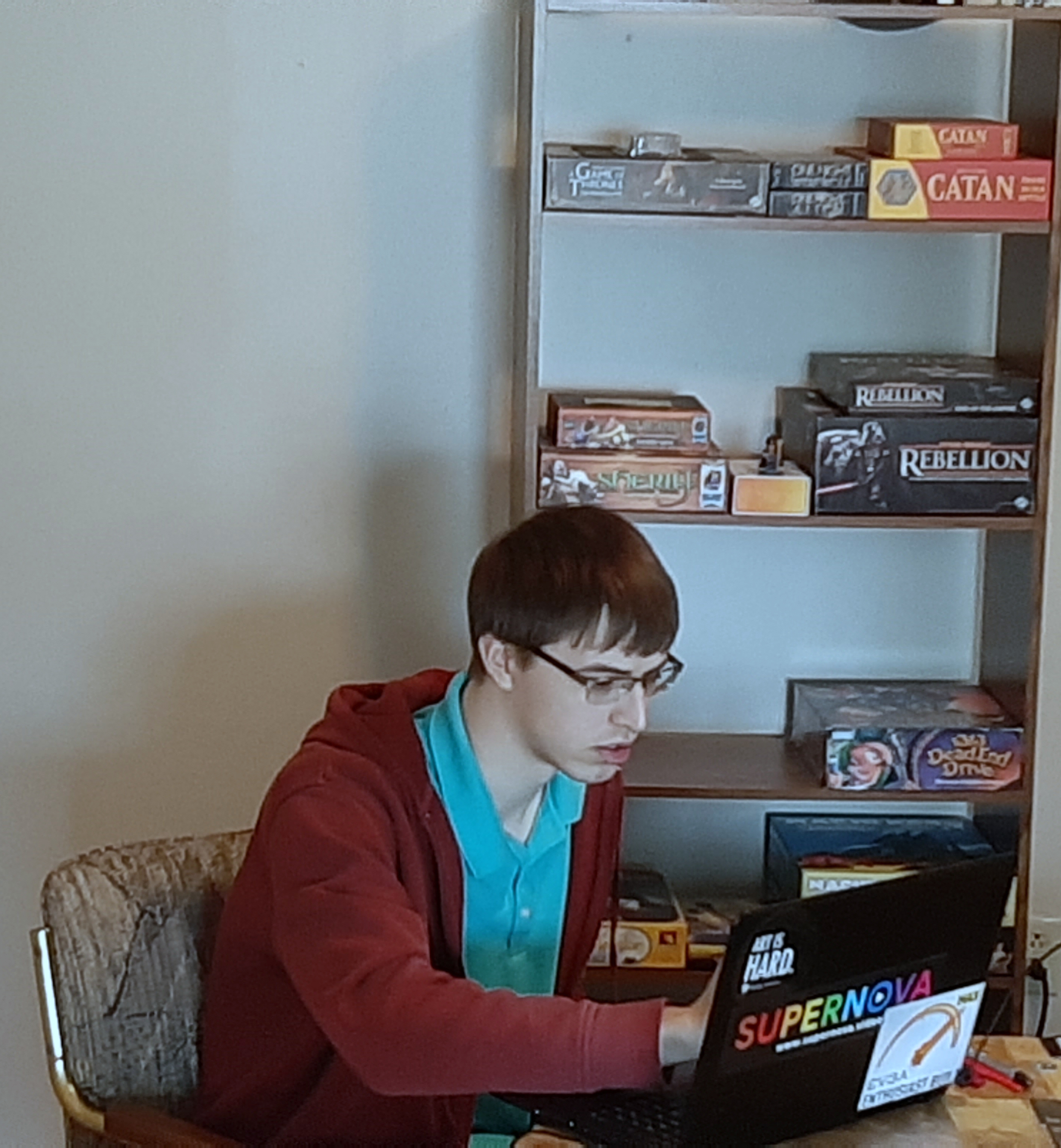
For my Steller story, which you can view here, I took pictures of my brothers Raymond and Jared as well as my father Russell. The point of my story was to give people a sample of some of the things we are doing to pass the time during the COVID 19 pandemic. The pictures showed a handful of activities that took place.

            The biggest challenge of this assignment was finding something that is picture worthy. There is a lot of nothing going on most of the time. Usually the most exciting part of my time is my morning run on a treadmill and doing my homework. Luckily, we live in a rural area in Michigan so we can all go outside more often than other people. This blog discusses some of the events that were photographed.

            Like all students, we have been learning online. All three of us have watched and listened to lectures on Blackboard, Zoom, and Facebook live. It is nowhere near as good as going to class in person and having face-to-face interactions with students and professors. Understanding that this is not the most exciting thing to look at, there are only two pictures of this.

            Jared, my older brother, is a graduate student earning a masters in statistics. To earn credit, he is required to teach a class to students. He was also forced to adapt to teaching online. The feature interview in my story is of him discussing his experience teaching online and what is lost teaching online.

            As mentioned earlier we are lucky enough to have a large property that allows us to go outside. We live on a farm; our house was built next to my grandpas house my dad could farm the fields and have access to the two barns outside our house which can be scene in a previous blog. Years later my dad has started a project in what used to be his parent’s garage.

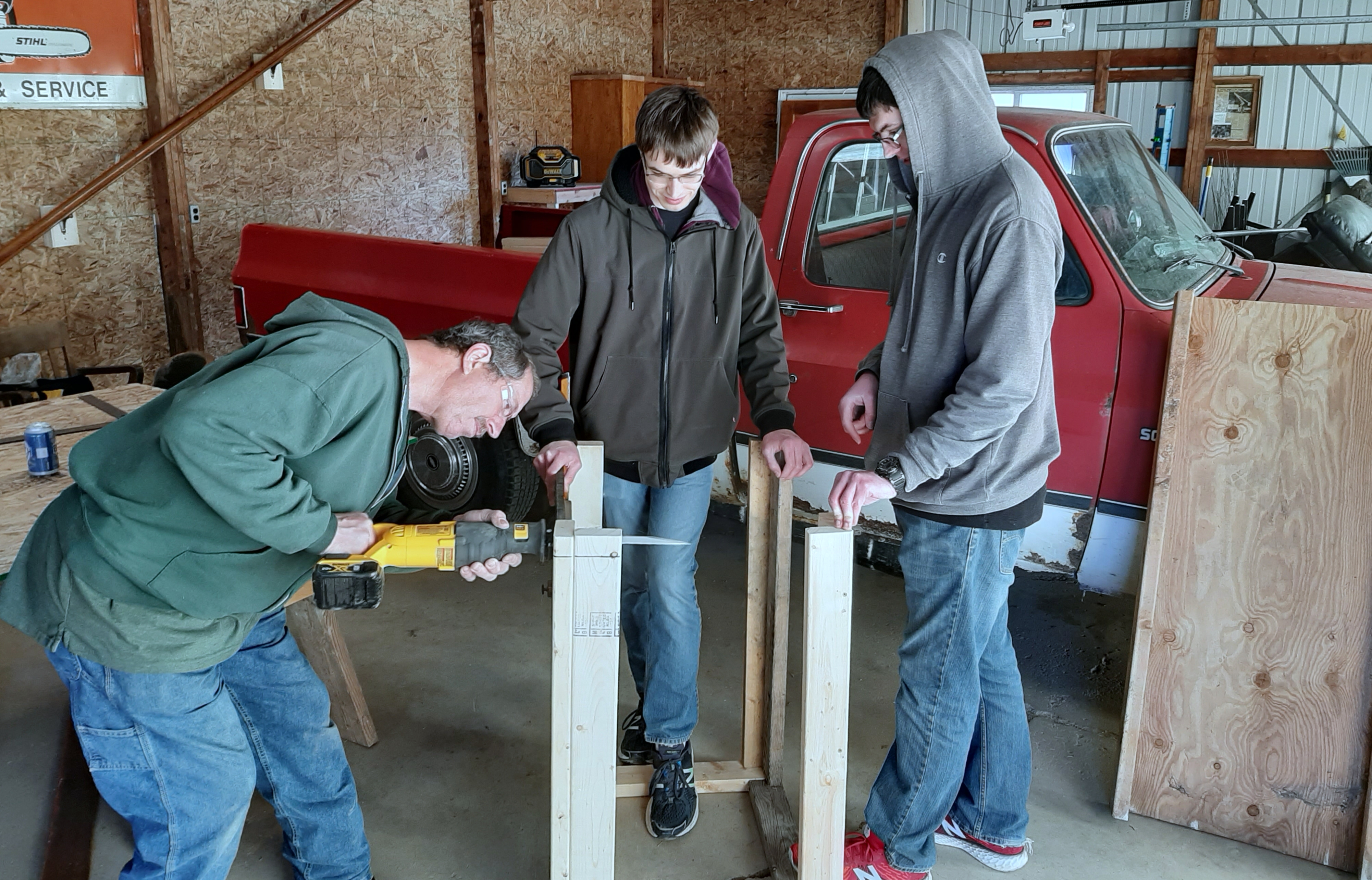
            My dad is building a workshop in his parent’s old garage, and since we have nothing better to do, the three of us have been helping him with whatever he needs. The biggest part of the project was putting up insulation to keep the place warm in the winter because there were a few small holes in the walls. We have also helped him build shelves that will be used for storage in the future. I enjoy this because it is nice to get some fresh air occasionally.

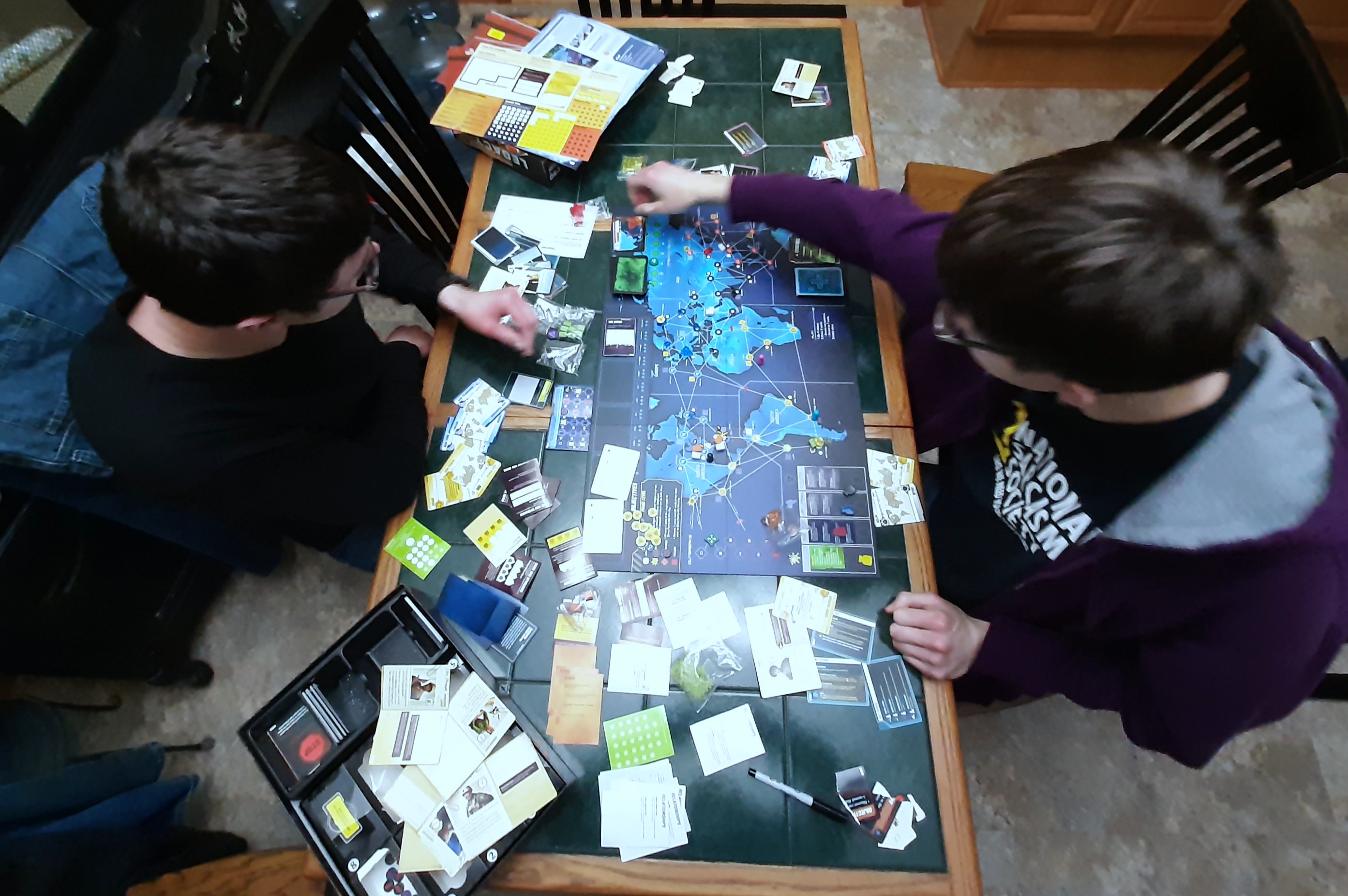
            Indoors we have enjoyed our boardgame. We have been playing a game called Pandemic Legacy. The object of the game is to work as a team to save the world from a global pandemic. Games in the Legacy series change every time you play because you are asked to place permanent stickers on the board or rip up certain cards.

            The only way to win is to play the game at least 12 times because each round is a different month. We would have been playing this anyway, but we felt weird dealing with a fictional pandemic and a real pandemic at the same time.

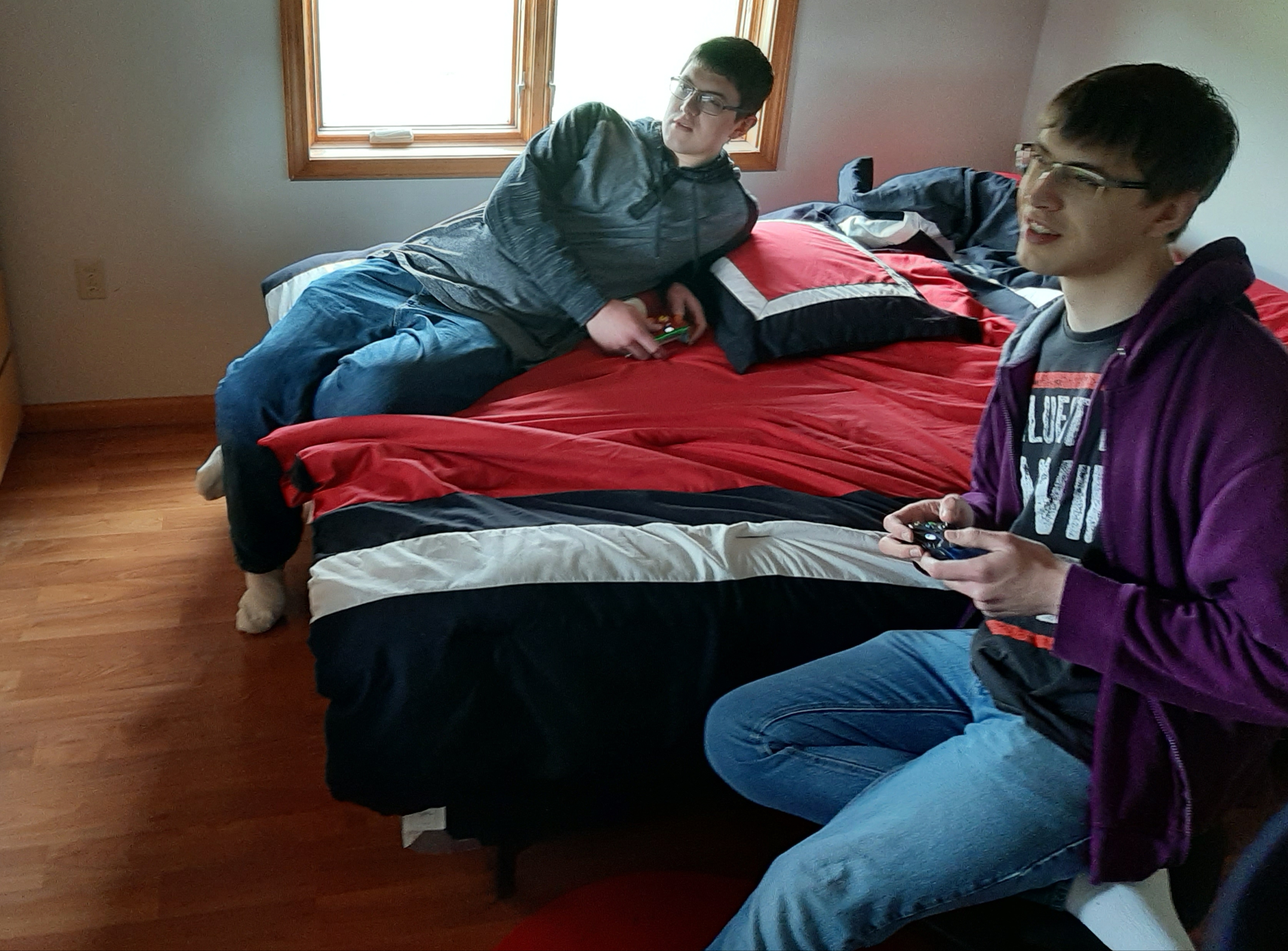
            We also have been playing video games to pass the time. Occasionally we get our parents to join us. We enjoyed hanging out together.

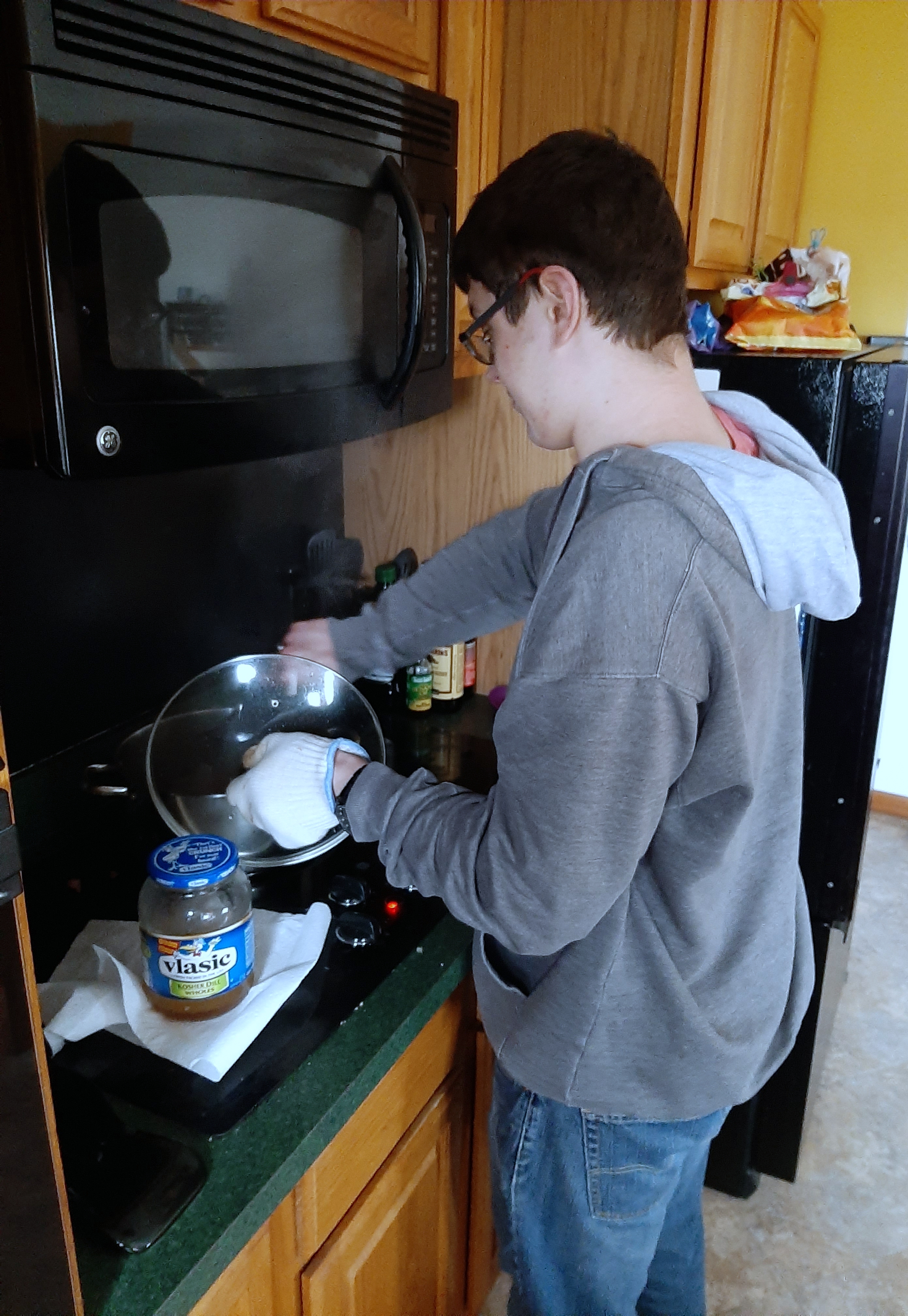
            The final and most important thing we have done together is cook meals. We have only ordered food one time during this entire pandemic. All meals but one has been home cooked.

Overall, I learned the importance of keeping my eyes open to find a picture-worthy moment. Here are a few pictures that were used in my story.

Lessons from NPPA Town Hall

On March 25, 2020 the National Press Photographer’s Association held on online town hall to give advice to journalists around the country on the best ways to handle the Coronavirus. They gave tips to journalists on how they can safely do their jobs They also tried to calm people who were stressed or worried about the current situation.                  

Marie De Jesús,photojournalist from the Houston Chronical, advised journalist to never go inside of a person’s house. The number one priority for journalists is to protect themselves and to protect their subjects. The best way to do this is to do stories remotely.

Julie Wolfe, News Director at WHAS 11 Louisville, explained that Journalists have resorted to online interviews. This includes doing interviews on Skype, Zoom or Facetime. Other journalists have resorted to interviewing a neighbor though his window while another stood on the street and interviewed some high schoolers while they stood in the driveway. One reporter said he used a shotgun mic so he could have his subject stand far away.

            Talking to local people is a good way to make sure you are not traveling to far for a story. During this crisis, everyone has a story to tell, anyone can be a story.

            Joe Little, Director of Storytelling at NBC 7, explained that another way to stop the spread of Corona is to make sure all reporters are traveling alone or always traveling with the same team. If reporters must travel with a team, they should make sure they are with the same people every time. Mixing up the teams every time would increase the chances of spreading the virus.

            Jesús also told journalist not to be afraid to say no. If you are told to do a story that would put you in danger, it is up to you to tell your boss no. They also told managers to be empathetic, do not send people into an environment where they could catch or spread the Coronavirus. For most people this should not be a problem, most people have enough common sense not to ask people to do something dangerous but there is always a handful who are greedy and do not put the safety of others first.

            With states issuing executive orders requiring all non-essential businesses to close, it is important that the media makes sure that they have exceptions to the orders. Mickey Osterreicher, NPPA General Counsel, advised all media personal to make sure they have access to the places they are trying to go to for a news story, they should always make sure they have their credentials or other form of paperwork. This will make sure they are not denied entry to somewhere important.

            Osterreicher also touched on the legal battle involving medical facilities refusing to give information. They refuse to give information regarding the amount of people who have Corona claiming that it is a HIPA violation. Journalists are encouraged to have off the record conversations to explain that they are trying to inform the public about what is going on.

            To keep the public’s attention Katie Schoolav, CNBC and NPPA Vice President, advised the media to have a variety of stories. It is important to always be informing people about the number of confirmed cases and the rising death toll, but if all you show is depressing stories viewers will turn away and stop watching. To avoid this news reporters should mix in positive and uplifting stories that came from this crisis. One example is a small private graduation ceremony done by a neighborhood.

            One last message was that this is only temporary and to remain calm, this will not last forever.

This is a link for the town hall, you should check it out!

Design a site like this with WordPress.com
Get started